The café
The café and its regulars
How a French immigrant's coffeehouse of 1858 moved onto Avenida de Mayo, hosted writers and artists in its basement, and kept its early decoration.
Look for an open date ↗Quick answer
The café first opened in 1858, founded by a French immigrant surnamed Touan and named after a Parisian coffeehouse. It reached its present block in 1880 and gained its door on Avenida de Mayo in 1898. From 1926 to 1943 an arts circle met in the basement, drawing writers, painters and musicians. It keeps its early decoration, and today the basement hosts jazz and tango artists.
A Parisian name in Buenos Aires
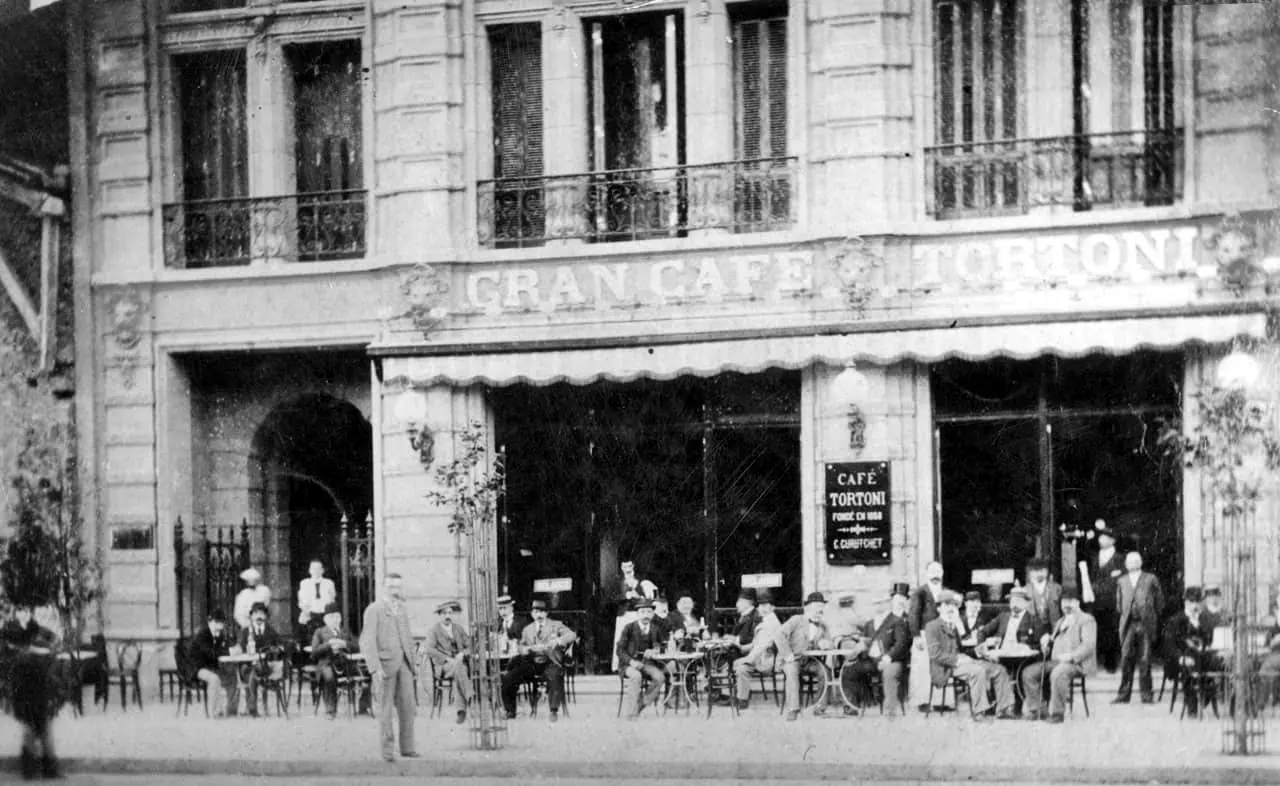
A French immigrant named Touan opened the coffeehouse in 1858 and called it after a café on the Boulevard des Italiens in Paris, a gathering place for that city's cultural elite in the nineteenth century. The original site was on the corner of Rivadavia and Esmeralda. At the end of the century, another Frenchman, Celestino Curutchet, bought the business. Its sellers today describe it as the oldest café in Buenos Aires, which is their phrase; the dates above are what the English Wikipedia article records.
Moving, then turning to face the avenue
In 1880 the café moved to its present location, on ground once occupied by a Scottish temple, the Templo Escocés. Its entrance at first was on the Rivadavia side of the block. The great new avenue came next: work started in 1885 and it opened in 1894. In 1898 the café opened an entrance on Avenida de Mayo, and the architect Alejandro Christophersen redesigned the façade. So the front that visitors photograph is younger than the business, and the business is older than the street it is now known for.
La Peña, downstairs
In 1926 an arts circle called La Peña was established in the basement, dedicated to protecting the arts and literature. It lasted until it broke up in 1943. Its visitors included the poets Alfonsina Storni, Baldomero Fernández Moreno and Juana de Ibarbourou, the pianists Arthur Rubinstein and Ricardo Viñes, the writers Roberto Arlt and Jorge Luis Borges, the philosopher José Ortega y Gasset, and the painters Florencio Molina Campos and Benito Quinquela Martín. A list like that explains the wax figures and portraits you will see around the rooms today.
Who else came through
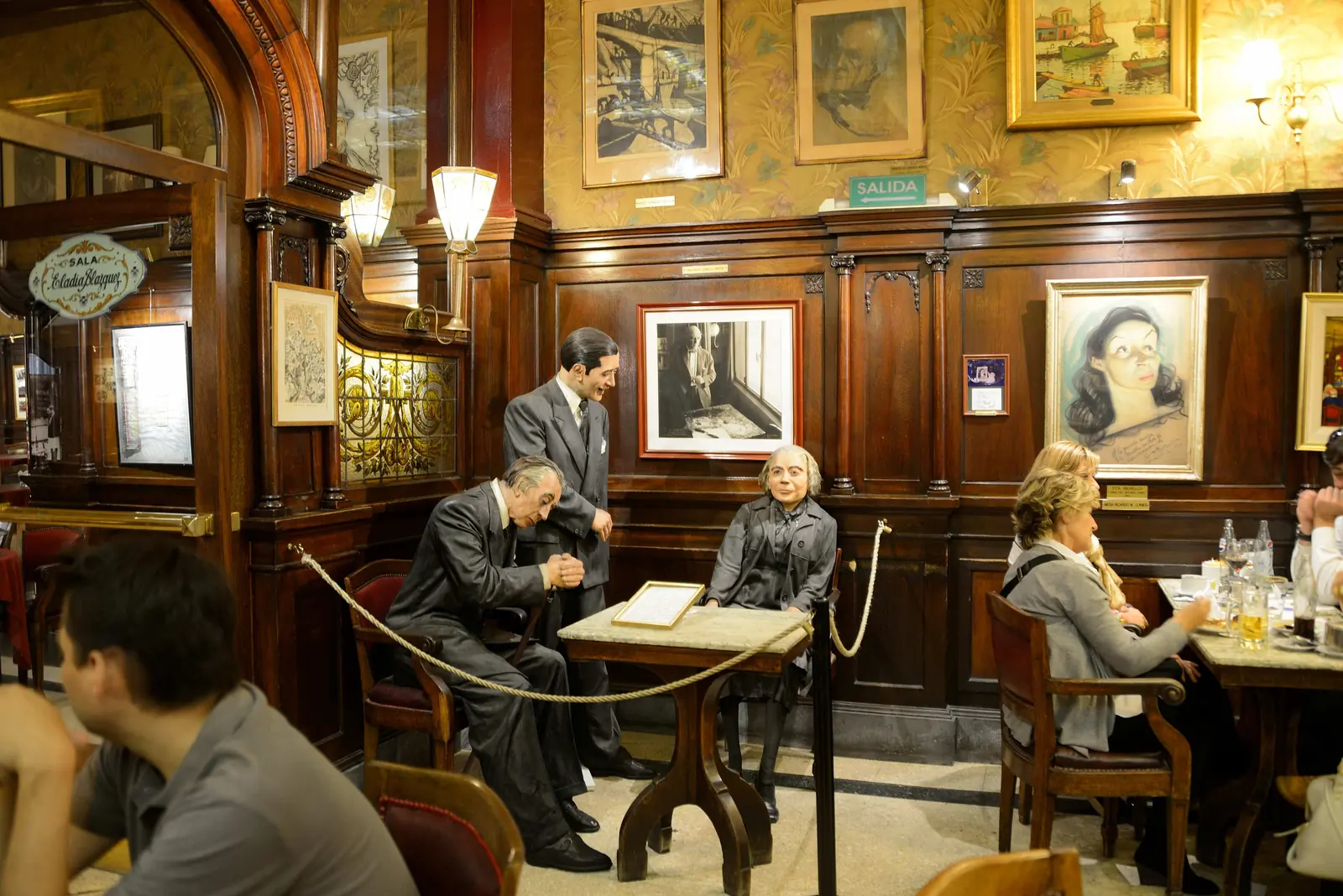
Over the years, the English Wikipedia article adds politicians such as Lisandro de la Torre and Marcelo Torcuato de Alvear, the popular idols Carlos Gardel and Juan Manuel Fangio, and international visitors including Albert Einstein and Federico García Lorca. Treat these as visits and not as residencies; the sources do not say how often anyone came. That is enough, though, to give the room its reputation. None of it tells you anything about tonight's show, which stands or falls on the people performing. It simply tells you why people want to sit here.
What the rooms look like now
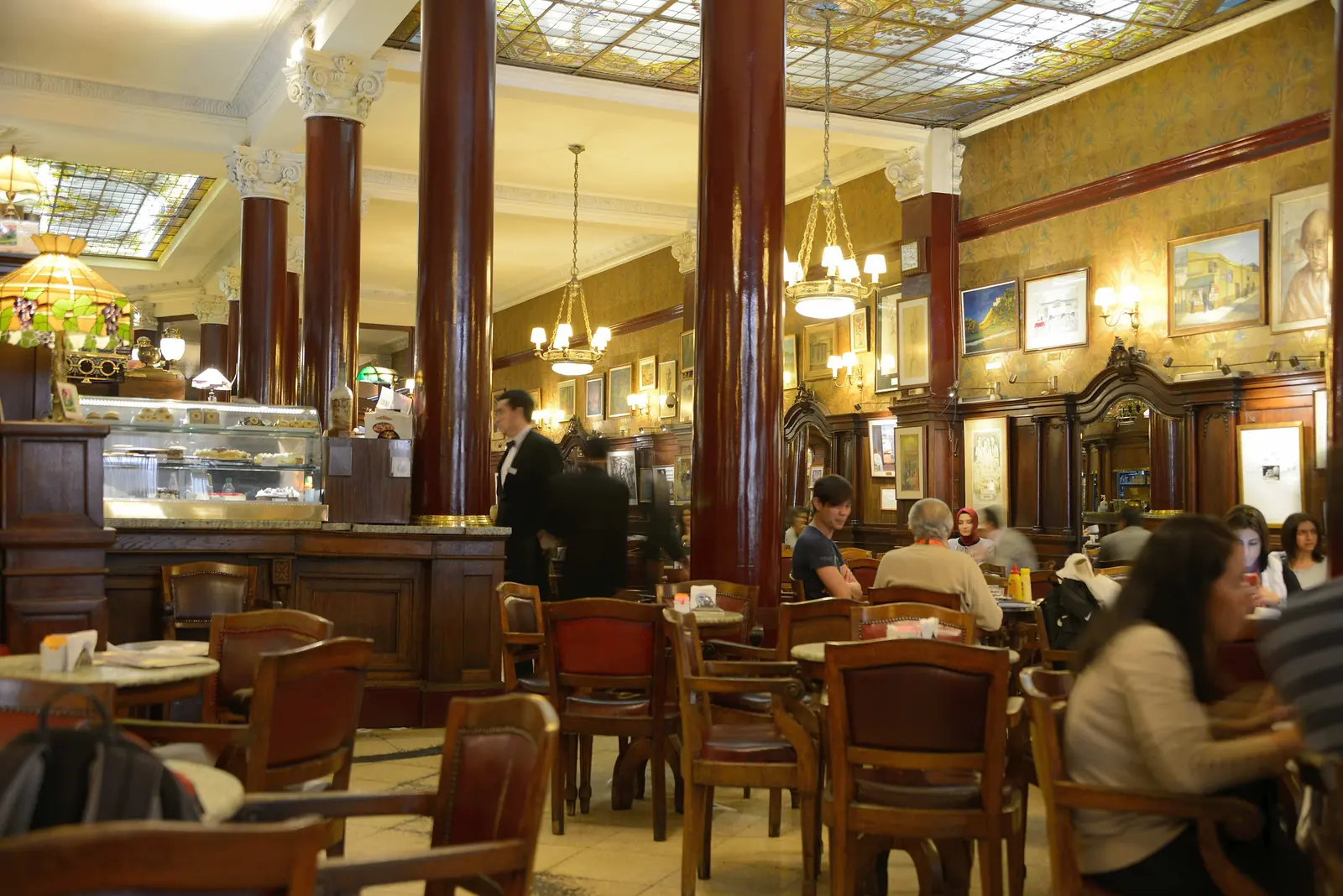
The café has conserved the decoration of its early years. Expect dark wood, columns, marble-topped tables and coloured glass overhead, with pictures covering much of the wall space. There is a library, and at the back are facilities for billiards, dominoes and dice. The basement works as a stage for jazz and tango artists and for book and poetry contests. Your show confirmation is the place to check where to go once you arrive. It is a working coffeehouse, so expect other customers and the ordinary noise of one around the edges of your visit.
Visiting without a show
The room is open to ordinary customers, and if the show calendar stays empty, this is the obvious consolation. Go for a coffee during the day, look at the glass and the pictures, and walk through to the back. Expect it to be busy, since a place with this reputation draws plenty of visitors, and there can be a wait at the door. It takes little time and costs only what you order. This guide does not handle reservations for the café, and it has no connection with the business.
Who this isn't for
If you dislike places that know they are famous, you may find the wax figures a bit much. Some visitors will prefer a neighbourhood bar with no history to speak of and no one taking photographs. The show also asks you to accept a historic room's limits: this is not a modern theatre built around sightlines. Anyone who wants a polished production with a large cast should look at the city's bigger stages. Choose this café when the room matters as much to you as the music.
Sources